Enrollment Cliff 2.0: What the New 4-Year Rule Will Cost Every U.S. College
By Reetu Gupta on Updated:
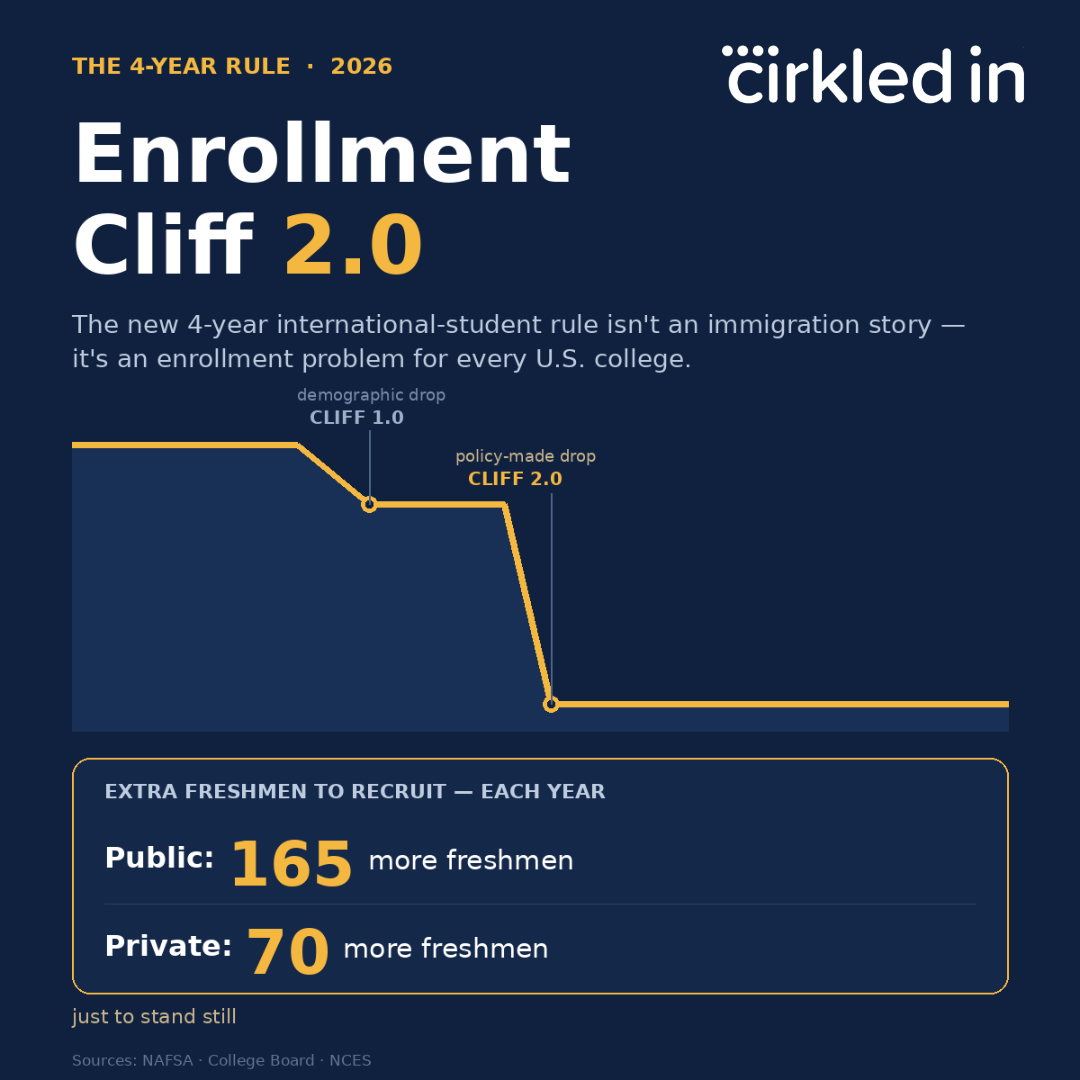
The new international student visa cap is being read as an immigration story. Run the numbers and it’s an enrollment story, one that reaches every campus, even the ones with almost no international students
Every enrollment leader already knows about the cliff: fewer 18-year-olds, arriving now: the demographic drop the sector has braced for since the birth-rate decline of the late 2000s. Call it Enrollment Cliff 1.0. Painful, but at least predictable.
The new federal four-year cap on international students, imposed through the Department of Homeland Security’s recently finalized rule ending “Duration of Status,” creates a second cliff for international students. It doesn’t shrink the pool of students, it removes hundreds of thousands of the full-paying ones already in it, and it does so by design. At Cirkled In, we call it Enrollment Cliff 2.0. Unlike the first one, the cost reaches every college, including those that enroll almost no international students at all.
We made the case for why this is an American problem, not just an international-student one. In a companion piece, “The New 4-Year Limit on International Students Is an American Problem,” lays out the human and economic stakes. What follows here is the math behind it.
Here’s the math.
Find Your Best-Fit College
Search and compare 7,000+ colleges and trade schools to find the ones that fit your goals and budget.
The $42.9 billion that quietly holds the system up
International students contributed $42.9 billion to the U.S. economy in the 2024–25 academic year, according to NAFSA. Most pay at or near full sticker price, with no institutional financial aid. Those dollars don’t sit in one place: they cross-subsidize scholarships for domestic students, keep small departments solvent, and underwrite the dorms, dining halls, labs, and the local economy around every campus.
Spread that contribution across the roughly 2,600 four-year colleges in the United States (NCES), and it works out to about $16.5 million per campus, every year. That $16.5 million is at risk.
How many domestic students would it take to replace that?
Suppose a campus wanted to backfill its share of that $42.9 billion with domestic students. How many would it need?
Each student a college recruits brings in tuition, and if they live on campus, they also bring room and board, which is college revenue too. Using College Board’s 2024–25 figures:
- A public four-year college collects about $11,610 in in-state tuition and fees plus $13,310 in room and board, about $24,920 per student.
- A private nonprofit collects about $43,350 in tuition and fees plus $15,250 in room and board, about $58,600 per student.
Divide the $16.5 million per campus by those figures, then divide by four (a student stays enrolled for four years, so each entering class is about a quarter of total enrollment), and you get the size of the additional freshman class a campus would need to recruit, every single year, just to stand still:
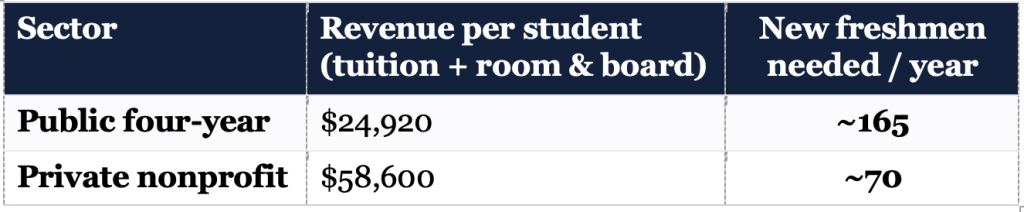
For a public campus, that’s roughly 165 additional freshmen a year. For a private, about 70. Every year, on top of the demographic cliff already shrinking the applicant pool. (Counting tuition alone and setting room and board aside, the figures climb to about 355 new freshmen a year at a public campus and 95 at a private one.)
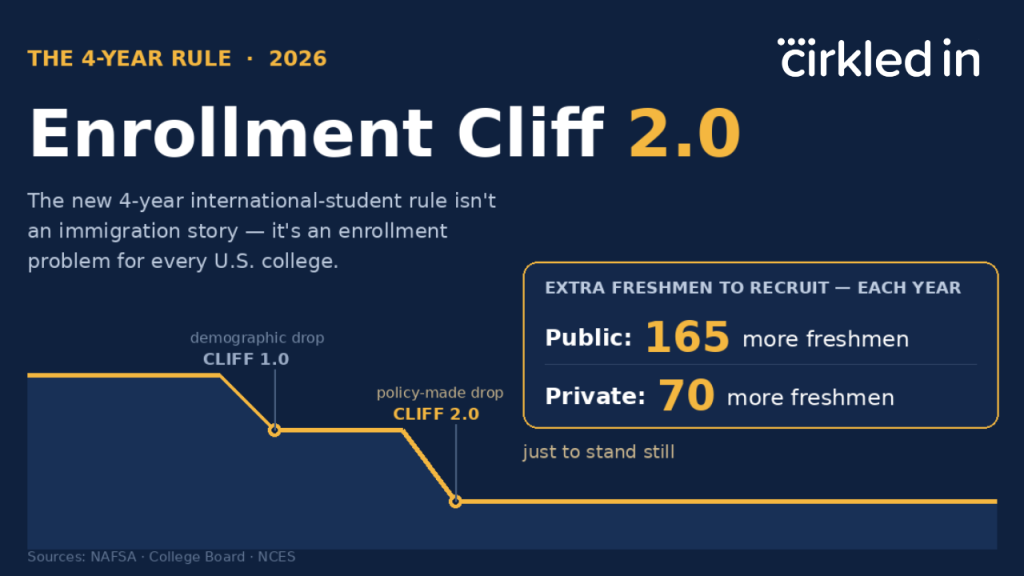 Enrollment Cliff 2.0 Cirkled In Analysis
And it’s actually worse: the discounting problem
Here is the part that makes the real number larger than the table suggests. International students pay close to full sticker, domestic students overwhelmingly, do not.
After grant aid, the average net tuition and fees a domestic student actually pays is about $2,480 at a public four-year college and about $16,510 at a private nonprofit, per College Board. Replacing a full-pay international student’s tuition with domestic tuition doesn’t take one student, it can take several. To net the same dollars, a campus may need far more domestic students than the sticker math implies.
The international premium
The same gap shows up on the public side another way. International students at public universities almost never pay the in-state rate; they pay the out-of-state rate or a higher international tier. On average, they pay around $33,500, roughly three times the $11,610 in-state rate, and at flagship publics the non-resident rate runs far higher still: about $66,200 at the University of Michigan and $62,900 at the University of Virginia for 2025–26, approaching four to five times in-state.
A public university that loses an international student and replaces them with an in-state freshman is swapping a premium check for one a fraction of the size. It would take several in-state students to close the gap.
Lower Your College Costs
Discover free money for college and start reducing what you’ll owe.
Where, exactly, will those students come from?
This is where Cliff 2.0 stacks on Cliff 1.0. The replacement students have to come out of a domestic pool that is already shrinking, and a domestic public more skeptical of the value of college than at any point in recent history.
So the students needed to offset this situation is dwindling. A smaller pool of students, and harder to convince of the value of higher education.
But we don’t recruit international students, so we’re safe. Right?
It’s the most expensive assumption an enrollment leader can make right now. Your exposure was never about who sits on your roster, it’s about who sits on the roster of the college twenty miles away. When a nearby institution loses its full-pay international revenue, it doesn’t fail quietly, it discounts deeper to fill seats, competing for the very domestic students you’re chasing. It may cut programs, or closes, and its stranded students, displaced faculty, and destabilized local economy wash straight into your region. The international student you never enrolled was still helping hold up your area’s price floor, your shared applicant pool, and your local economy.
Closures are already running at levels that were unthinkable a decade ago. By one analysis of federal data, 726 degree-granting institutions, nearly one in seven, closed between 2013 and 2023, and the Federal Reserve Bank of Philadelphia projects up to 80 more closures within five years. Pull full-pay students out everywhere at once, and every campus fights harder over a shrinking domestic. A closure two towns over isn’t a rival’s bad luck, it’s a preview. There is no safe position on this cliff.
What colleges can do now
None of this is a reason to wait and see. The one lever a campus fully controls is its domestic pipeline, and that is where the response is critical. The institutions that come through this will be the ones that get sharper about domestic recruitment now: reaching the right students, in the right places, with the right message, before the competition for a shrinking pool intensifies.
That is exactly what Cirkled In was built for: helping colleges find and engage domestic students through targeted search and direct promotion, reaching a platform of more than 1.5 million students filtered to the profiles that fit each program. If Cliff 2.0 is coming for the international side of your funnel, the smart hedge is to strengthen the domestic side.
– By Reetu Gupta, Vice President of Education at Cirkled In, where she leads growth, partnerships, and content strategy connecting students with colleges, scholarships, and careers.
Methodology & assumptions
The per-campus figure is a directional estimate meant to convey scale, not a line-item budget projection. A few notes on how it was built, and the assumptions that could move it in either direction:
- The $42.9 billion (NAFSA) is total economic contribution (tuition and fees plus living expenses plus supported jobs), not college revenue alone. Treated purely as budget, the per-campus figure would be smaller; treated as total dollars flowing through a campus economy, it is fair as stated.
- Room and board counts as college revenue only for students living on campus; for those living off campus, housing dollars flow to local landlords rather than the institution.
- Sticker vs. net: the freshman figures use published tuition. Because domestic students receive far more institutional aid than international students, the real domestic backfill required is likely larger than the table shows, not smaller.
- The four-year divisor assumes steady-state enrollment (each entering class ≈ one quarter of the student body). Programs longer than four years would lower the annual figure slightly.
- College counts range from roughly 2,270 to 2,640 four-year institutions depending on definition (NCES); 2,600 is used as a conservative round figure.
Sources
- NAFSA International Student Economic Value analysis (2024–25);
- College Board, Trends in College Pricing and Student Aid 2024;
- National Center for Education Statistics (NCES / IPEDS);
- Gallup (confidence in higher education, 2026);
- Federal Reserve Bank of Philadelphia (college-closure projections).
About Cirkled In
Cirkled In helps colleges and universities engage and recruit students more effectively by providing access to high-quality prospect data, targeted hand-raiser inquiries, and actionable insights into student interests and pathways. Our platform supports enrollment leaders in building diverse and robust pipelines, connecting with students, and optimizing recruitment strategies for today’s competitive higher education landscape.
FAQ:
Q: What is Enrollment Cliff 2.0?
Enrollment Cliff 2.0 is Cirkled In’s term for the enrollment shock from the new federal 4-year cap on international students, stacking on top of the demographic “enrollment cliff” (Cliff 1.0). Cliff 1.0 shrank the pool of students; Cliff 2.0 raises the number of domestic students each college must recruit from that shrinking pool.
Q: How does the rule affect colleges that enroll few international students?
Every campus is exposed. When a nearby college loses full-pay international revenue, it discounts deeper, cuts programs, or closes, sending its students and instability into your region and intensifying competition for the same domestic students.
Q: How many more domestic students would a college need to replace the lost revenue?
Roughly 165 more freshmen a year at a public campus and about 70 at a private one, just to stand still.
#Student Visa #International Students #Higher Education #College Enrollment #College Admissions #Education Policy #College Affordability #Future of Higher Education #International Enrollment
$2,500 No-Sweat Scholarship
Five minutes to apply for $2,500 toward college. No essay marathon required.