Cirkled In Join Free
  • Build your portfolio
    🎒Your whole story200+ data points, beyond grades
    • Build your portfolio Open →
    • Upgrade Open →
    • Contact us Open →
    • FAQ Open →
    • Example profiles
      • Elementary student
      • Middle school student
      • High school student
      • College student
    Start your portfolio — it's free
  • Find your best-fit college
    🏛7,000+colleges & trade schools
    • All colleges Find →
    • 4-year public universities Find →
    • 2-year public universitiesFind →
    • 4-year private universitiesFind →
    • 2-year private universitiesFind →
    • HBCU colleges Find →
    Find your college match
  • Find scholarship money
    💰6,500+scholarships — updated daily
    • $2,500 No-Sweat Scholarship ours
    • All scholarships Find →
    • No-essay scholarships Find →
    • GPA scholarships Find →
    • High School Student scholarshipsFind →
    • College Student scholarshipsFind →
    Find the money with your name on it
  • Search internships & jobs
    💼23,000+opportunities — updated daily
    • All Internships & Jobs Search →
    • Paid internships Search →
    • Part-time jobs Search →
    • Remote jobs Search →
    • College Student InternshipsSearch →
    • Volunteering Opportunities Search →
    Browse all opportunities
  • Tutors, counselors & more
    • Partners Open →
  • Read guides & articles
    📚600+featured now · application season
    • All library articles Read →
    • College Applications & Admissions Read →
    • Resume & Portfolio Building Read →
    • Scholarships & Financial Aid Read →
    • Extracurriculars & Leadership Read →
    • Career Planning & Development Read →
    • Student Success Stories Read →
    Browse the full library
  • Cirkled In for...
    💙ParentsSupport your student's journey 🏫K-12 EducatorsGuide students, write recommendations 🏛CollegesRecruit best-fit students 💼EmployersPost jobs, find student talent 🤝 Service Providers Tutors, counselors & consultants
  • Log In
  • 🎓 Join Free
Cirkled In
  • Student
    • Student Portfolio
    • Find Colleges
    • Find Internships/Jobs
    • Find Scholarships
    • Resource library
  • K-12 Educators
  • Colleges
  • Employers
  • Resource library
  • Help
    • FAQ
    • Resource library
    • Contact
  • Login
  • User Name
    • My Profile
    • My Subscription
    • Logout
  • Sign Up
Home / College Applications and Admissions / The New 4-Year Limit on International Students Is an American Problem

The New 4-Year Limit on International Students Is an American Problem

By Reetu Gupta on July 18, 2026 Updated: August 31, 2026

New 4-year student visa rule impact on international students and U.S. colleges

A rule aimed at foreign students will raise tuition for domestic families, drain local economies, and push more colleges to close. Here’s the part almost no one is talking about.
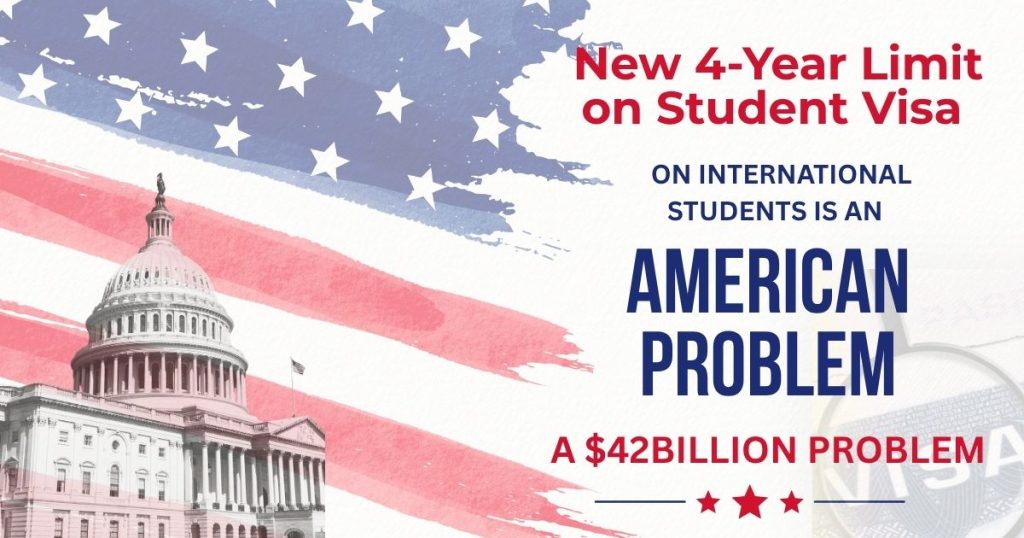
Student visa 4 yr limit 1260X650

Somewhere in Hyderabad or Pune, in Lagos or Seoul, a family is doing math at the kitchen table tonight. Not “which university has the best ranking.” The real math is simpler—and heavier:

Can we afford this? And if we can, is America still the safest bet?

That question has become more urgent after the new 4-year student visa rule, a policy change that could reshape how international students plan their education in the United States — and how American colleges think about enrollment, revenue, and growth.

Historically, for millions of families, the answer has always been yes — because a U.S. education was never just a degree. It was a doorway. A lifetime of savings, a second mortgage, a grandparent’s pension, all wagered on one child’s shot at building a life in America and earning in dollars.

Last week, the U.S. government made that doorway much narrower. And while the headlines file it under “immigration,” it is going to land — hard — on American families who have never met an international student in their lives.

Find Your Best-Fit College
Explore your options and find the campus that’s right for you.
Find Colleges

What actually changed

On July 16, 2026, the Department of Homeland Security finalized a rule ending “Duration of Status,” the policy that since 1978 allowed international students to remain in the U.S. for as long as their academic program lasted.

In its place: a fixed four-year admission period. Students who need longer must file a discretionary extension with USCIS — one that carries a fee, requires biometrics, and creates additional uncertainty for students who need more time. The rule also restricts changing majors or transferring institutions midstream, and cuts the post-graduation grace period from 60 days to 30. It takes effect September 15.

DHS frames it as a screening tool to confirm students are making normal academic progress. On paper, four years sounds reasonable. In practice, the average time to earn a bachelor’s degree already exceeds four years, almost no Ph.D. finishes in four, and the work experience students count on through OPT routinely pushes past the line.

The impact is especially acute for graduate students and researchers, whose work often extends beyond four years and who contribute significantly to the research ecosystem that powers American universities.

Why this isn’t like the last visa scare

We’ve been here before — sort of. Interview backlogs. Travel bans. Processing delays. Each one dented international enrollment; new international enrollment fell 17% 2025 fall alone, according to the Institute of International Education’s Open Doors 2025 report . But those were friction. Friction is temporary. When it clears, students come back.

This is not friction. This is a change to the underlying decision. Families don’t spend life savings based on hope. They spend it based on certainty.

When a family stakes everything on a child’s future abroad, they aren’t buying a diploma. They’re buying a pathway: study, work, build, belong. Put a four-year fuse on that pathway — and make the extension a discretionary USCIS filing at an agency already handling more than 11 million pending immigration cases — and you haven’t just slowed the decision down. You’ve removed the reason to make it.

They don’t come for a degree. They come to build a life. And behavior, once changed, doesn’t snap back.

A family that decides this year to send their child to Canada, the UK, or Australia instead won’t reverse that in 2028 because a rule softened. They’ll tell their siblings. Their neighbors. Their WhatsApp groups. We are not just risking a temporary decline. We are risking a long-term shift in where the world’s most ambitious students choose to build their futures.

Follow the money: who really pays

Now trace the dollars, because this is where it stops being someone else’s problem. American higher education has quietly become financially dependent on attracting global talent.

International students contributed $42.9 billion to the U.S. economy last year, according to NAFSA.

Most pay full sticker price with no institutional financial aid. That money doesn’t sit in one department. At many colleges, international tuition revenue helps subsidize institutional aid for domestic students while supporting programs, research, and campus operations. It keeps the small, “unprofitable” majors — languages, physics, philosophy — alive. It underwrites the labs, the dorms, the campus jobs, and the coffee shops and landlords in the town around the college.

Pull that revenue out, and the hole doesn’t disappear. Colleges have only a handful of options: cut programs, freeze hiring, reduce student services, defer maintenance—or raise tuition for the students who remain — domestic families.

Lower Your College Costs
Search 6,500+ verified scholarships matched to your GPA, major, and interests.
Search Scholarships

At the worst possible moment

Colleges aren’t entering this moment from a position of strength.

  • 38% Public Confidence: This matches the historical low recorded by Gallup regarding overall American confidence in higher education. Only 35% now say a college education is “very important” to success—down from 75% in 2010.
  • 77% to 59% ROI Drop: According to the 2026 State of Higher Ed Report published by the National Society of Leadership and Success (NSLS), family satisfaction with the financial return on investment of a college tuition dropped from 77% to 59% in a single year.
  • 33% of U.S. adults would recommend a vocational or trade school: A growing number of families are reconsidering the traditional four-year college path. A 2025 Workforce Monitor survey by the American Staffing Association and The Harris Poll found that 33% of U.S. adults would recommend a vocational or trade school for graduating high school seniors, compared with 28% who would recommend a four-year college.

Americans’ confidence in higher education has fallen to just 38%, while concerns about whether college is worth the cost continue to grow. This skepticism comes at exactly the moment many institutions are becoming more financially dependent on tuition revenue.

So picture the sequence: international revenue evaporates, colleges raise domestic tuition to cover the gap, and they raise it on the exact families who are already the most convinced college isn’t worth the price. That’s not a recovery plan. That’s an accelerant.

When “enrollment problem” becomes “American problem”

Which brings us to the closures — where this quietly stops being an enrollment-office concern and becomes a community one.

Colleges are already closing at a pace that would have been unthinkable a decade ago. According to data tracked by the National Center for Education Statistics (NCES), 726 degree-granting institutions — nearly one in seven — closed between 2013 and 2023. The Federal Reserve Bank of Philadelphia projects up to 80 more could shut down over the next five years, driven by the demographic “enrollment cliff” of fewer 18-year-olds. This new rule is fuel on that fire.

When a college closes, it doesn’t close quietly. It takes the largest employer in a rural county with it. It strands students mid-degree. It empties storefronts, drags down home values, and erases the one institution that gave a small town a reason for its young people to stay. A closure two towns over isn’t a competitor’s misfortune. It’s a preview.

Screenshot 2026 07 18 at 12.45.52 PM
Current Status by the numbers

The reframe

Here’s the reframe I wish more people would make: the four-year rule is not a story about foreigners. It’s a story about who pays to keep American higher education standing — and what happens to American towns when the math stops working.

For families — domestic and international alike — the takeaway is the same one it’s always been, just with higher stakes: plan the whole path, not just the first step. Know the timeline. Know the deadlines. Know whether the school you’re betting on will still be there in four years. That clarity is the entire reason we built Cirkled In — to help students plan a future, not just pick a logo.

We are quietly walking away from one of the best bets this country ever made: that the world’s most ambitious young people would come here, build here, and stay. The bill for that decision won’t arrive on a foreign student’s desk. It’ll arrive in an American family’s tuition statement — and in a shuttered campus down the road.

Policies like this aren’t measured only in visa approvals. They’re measured in enrollment decisions, tuition bills, campus closures, and the opportunities America quietly gives away. Those costs won’t be paid only by international students. They’ll be paid by American families, American communities, and American higher education itself.

Find Your Dream College or Trade School

Explore 7,000+ colleges, universities, and trade schools to discover the right fit for your goals, interests, and future career.

Find Colleges

– By Reetu Gupta, Vice President of Education at Cirkled In, where she leads growth, partnerships, and content strategy connecting students with colleges, scholarships, and careers.

#Student Visa #International Students #Higher Education #College Enrollment #College Admissions #Education Policy #College Affordability #Future of Higher Education #International Enrollment

$2,500 No-Sweat Scholarship
Real students win our $2,500 scholarship every quarter — yours could be next.
Apply Now
Keep Reading
Related Articles
The International Student’s Guide to US Financial Aid & ScholarshipsUnderstanding College Costs: Public vs. Private vs. Out-of-State (Which is Really More Affordable After Aid?)Impact of High School Course Rigor: AP, IB, Dual Enrollment & College Admissions“Need-Blind” vs. “Need-Aware” Admissions: What It Means for Your Application & AidDo Colleges Accept Late Applications?  (Or Are You Out of Luck?)College Budget Bootcamp: Your Money Plan for College Success
Why Cirkled In?
You’re more than a test score — get discovered.

You have a story, and Cirkled In helps you tell it — shining a light on who you are so the right colleges find you. Find your dream college, gain real experience, and win scholarships, all at one hub.

Create My PortfolioResearch 7,000+ CollegesFind 6,500+ ScholarshipsExplore 24,000+ Internships, Jobs & VolunteeringWin the $2,500 Scholarship
Categories: College Applications and AdmissionsCirkled In Specific
Tags: College AdmissionsCollege EnrollmentEducation PolicyHigher EducationInternational StudentsStudent Visa

0 Comments

Leave a Reply Cancel reply

Comment LogoUser profile avatar placeholder

Your email address will not be published. Required fields are marked *

Recent Posts
  • Cirkled In Going Merry Alternative for scholarship administrators
    Running Your Scholarship on Cirkled In: A Guide for Administrators Switching from Going Merry
Recent Comments
  1. Amy S on Virtual Volunteering Opportunities: Making an Impact from Home
  2. Amy S on Paid Internships vs. Unpaid Internships: Weighing the Pros and Cons (and Knowing Your Rights)
  3. Amy S on Digital Detox Challenge: A 7-Day Plan to Reset Your Relationship with Your Phone
  4. Amy S on State-Specific Financial Aid Programs You Might Be Missing Out On
  5. FabianMorano on State-Specific Financial Aid Programs You Might Be Missing Out On
Archives
  • September 2026
  • August 2026
  • July 2026
  • May 2026
  • January 2026
  • October 2025
  • June 2025
  • May 2025
  • April 2025
  • March 2025
  • February 2025
  • December 2024
  • October 2024
  • June 2024
  • April 2024
  • December 2023
  • November 2023
  • August 2023
  • June 2023
  • May 2023
  • April 2023
  • March 2023
  • February 2023
  • January 2023
  • December 2022
  • November 2022
  • October 2022
  • September 2022
  • August 2022
  • June 2022
  • May 2022
  • April 2022
  • February 2022
  • January 2022
  • December 2021
  • November 2021
  • September 2021
  • August 2021
  • July 2021
  • June 2021
  • May 2021
  • April 2021
  • March 2021
  • February 2021
  • January 2021
  • December 2020
  • November 2020
  • October 2020
  • September 2020
  • August 2020
  • July 2020
  • June 2020
  • May 2020
  • April 2020
  • March 2020
  • February 2020
  • January 2020
  • December 2019
  • November 2019
  • October 2019
  • September 2019
  • July 2019
  • May 2019
  • April 2019
  • March 2019
  • February 2019
  • November 2018
  • September 2018
  • August 2018
  • July 2018
  • June 2018
  • April 2018
  • November 2017
  • October 2017
  • May 2017
  • November 2016
Categories
  • Mental Health and Well-Being (52)
  • Resume and Portfolio Building (61)
  • College Applications and Admissions (103)
  • Scholarships and Financial Aid (54)
  • Career Planning and Development (39)
  • Internships and Job Opportunities (44)
  • Extracurricular Activities and Leadership (41)
  • Student Success Stories (22)
  • Cirkled In Specific (90)

Related Posts

Common App Essay Prompt #7 1080X1080px

Common App Essay Prompts: Question 7

College Applications and Admissions

Common App Essay Prompt 7 lets you write about any topic of your choice. Learn how to choose a story that reveals something meaningful about you, adds depth to your application, and shows admissions officers who you are.

Common App Essay Prompt #6

Common App Essay Prompts: Question 6

College Applications and Admissions

Question 6: Describe a topic, idea, or concept you find so engaging that it makes you lose all track of time. Why does it captivate you? What or who do you turn to when you Read more…

Common App Essay Prompt #5

Common App Essay Prompts: Question 5

College Applications and Admissions

A visual guide to Common Application Essay Prompt 5, focusing on personal growth, meaningful experiences, changing perspectives, and lessons learned.

Popular searches
Updated daily

🏛️ Colleges

  • Public Colleges
  • Private Colleges
  • HBCU Colleges
  • 4‑Year Colleges
  • 2‑Year Colleges
  • Compare Colleges
All 7,000+ colleges →

💰 Scholarships

  • No‑Essay Scholarships
  • STEM Scholarships
  • Scholarships by Major
  • For High School Students
  • For College Students
  • $2,500 No‑Sweat Scholarship
All 6,500+ scholarships →

💼 Internships & Jobs

  • Paid Internships
  • Part‑Time Jobs
  • Remote Jobs
  • High School Internships
  • Volunteering Opportunities
  • IT & Software Jobs
All 23,000+ opportunities →

📚 Guides

  • College Application Timeline
  • Early Action vs. Early Decision
  • Scholarship Search Strategy
  • Internship Interview Question Bank
  • Scholarship Scams to Avoid
  • Understanding Student Loans
All 600+ articles →
Cirkled In

One profile, one platform, endless opportunity. The #1 student portfolio platform — free for students, forever.

Bellevue, WA 98004
contact@cirkledin.com

Discover

  • Find Colleges
  • Scholarships
  • Internships & Jobs
  • Volunteering
  • Resource Library

Who we serve

  • Students & Parents
  • K‑12 Schools & Educators
  • Colleges
  • Employers

Company

  • Contact
  • FAQ
  • $2,500 No‑Sweat Scholarship
  • Privacy Policy
  • Terms of Use

Your future starts with one profile.

🎓 Create Your Free Profile →
Schedule a Demo
FERPA & COPPA compliant · SSL secured · Free for students
© 2026 Cirkled In. All rights reserved. Trusted by 1.5M+ students