Common App Essay Prompts: Question 1
By Amy S on Updated:
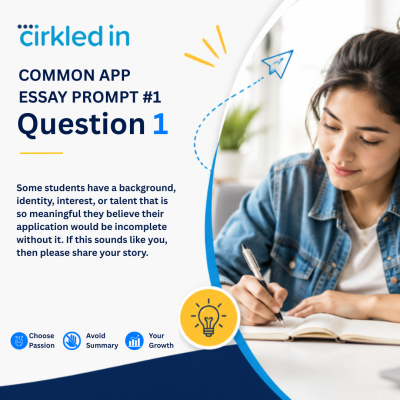
Question 1: Some students have a background, identity, interest, or talent that is so meaningful they believe their application would be incomplete without it. If this sounds like you, then please share your story.
Identity — what makes you, you? This is typically the most popular Common Application prompt, because we all have a story to tell about what makes us the way we are. But just because it’s the most-picked prompt doesn’t mean it’s the easiest. It’s actually one of the riskiest — because “tell me about yourself” is so open-ended that it’s easy to write something vague, generic, or trying to cover too much at once.
Colleges are trying to get to know YOU by reading your application, but that’s hard to do with only test scores and a GPA. This essay fills the gap by directly telling colleges about pieces of your identity that don’t show up on paper. Where do you come from? What’s your family life like? What’s something you’re passionate about that may be non-academic?
Why This Prompt Trips People Up
Because it’s so broad, students often make one of two mistakes: they pick something too big (their entire cultural background, their whole childhood) and end up skimming the surface of everything, or they pick something too small (a random hobby) without explaining why it actually matters to who they are. The best Question 1 essays do the opposite — they zoom in tight on one specific thread and follow it all the way through to a real insight about themselves.
 Common App Essay Prompt 1 – The Identity Essay
3 Tips for Conquering This Prompt:
1. Choose a part of your identity that you are passionate about.
Just because you grew up in a household with divorced parents doesn’t mean you are obligated to write about this. Maybe you don’t feel like that part of your life has dramatically shaped you. That’s okay. There are dozens of unique aspects of your background, so only write an essay about one you are eager to share.
2. Avoid summarizing too much
Rather than trying to include everything about your identity in one essay, focus on a single aspect of yourself. Colleges want to understand what excites you, what influences your environment, and what makes you unique compared to other applicants.
Avoid writing an essay that simply summarizes events. Instead, explain the thoughts and emotions behind your identity. Do not spend too much time describing the sequence of events. For example, if you are writing about loss, focus on the impact of one person’s passing to represent your experience with grief.
3. Show how you have grown.
It is not enough to simply describe events from growing up in a low-income family. You must describe why these events make you the person you are today. Colleges look for students who are able to grow and learn from experiences (because college is essentially an experience that we are expected to learn from, right?). So, show colleges that your interests and background has molded you to where you stand today.
A Simple Structure to Work From
If you’re staring at a blank page, try this shape:
- Hook: Open on a specific moment or image, not a summary statement. (“I still remember the smell of my grandmother’s kitchen” beats “I come from a close Filipino family.”)
- Context: Give just enough background for the moment to make sense — don’t over-explain.
- The turn: What did this experience make you notice, question, or realize about yourself?
- Growth: How did that realization change how you think or act?
- Forward look: Gesture (briefly) toward how this piece of you shows up in how you’ll engage with college — without turning it into a “Why Us” essay.
Common Mistakes to Avoid
- Trying to fit your entire life story into 650 words.
- Writing what you think colleges want to hear instead of what’s actually true for you.
- Describing an identity or background without ever showing your own actions or voice inside it.
- Ending on “and that’s why I’m resilient/unique/hardworking” without earning it through the story.
- Choosing a topic because it sounds impressive rather than because it’s genuinely meaningful to you.
 Cirkled In: Common Application Prompts: Question 1
Prompt 1 vs. Prompt 7 — How to Tell Them Apart
Question 1 and Question 7 (“Share an essay on any topic of your choice”) get confused a lot, since Q7 can technically cover identity too. The difference: Q1 asks you to frame your essay explicitly around a background, identity, interest, or talent that’s central to who you are — it wants that throughline named and explored. Q7 is truly open — better suited if your best story doesn’t neatly fit “identity” but still reveals character. If you’re not sure your idea is “identity” enough for Q1, that’s usually a sign it belongs under Q7 instead.
Final Thought
Question 1 rewards specificity, not scope. Pick the one thread of your identity that actually matters to you, follow it into a real moment, and let your growth do the talking. That’s what separates a Q1 essay that shines from one that just checks the box.
🔓 Want the full insider view on what admissions readers are actually scoring you on? Check out Decoding the Hidden Curriculum of College Applications for what colleges want but rarely say out loud.
✨ Not sure your draft has “it” yet? Our breakdown of College Application Essays That Shine decodes the authenticity, storytelling, and reflection that make essays land.
Want more college admissions tips? Check out Cirkled In Library for expert advice and tools to help you build a winning college application and land a spot at your dream school!
Check out Cirkled In and start owning your future today!
Check our other Common App Essay Prompts: